

Baroque architecture
Ca. 1600-1725 a highly decorative and theatrical style which appeared in Italy in the early 17th century and gradually spread across Europe. Baroque architects took the basic elements of Renaissance architecture.
Kariskirche, Vienna - Austria (1737)

The exterior of the Karlskirche in Vienna was designed by Fischer von Erlach, an Austrian architect, sculptor, and architectural historian whose Baroque style greatly influenced the Habsburg Empire. The twin columns are inspired by those of Solomon’s Temple.
Santa Maria Di Montesanto and Santa Maria Dei Miracoli, Rome - Italy (1677)

The significance of the twin churches, Santa Maria di Montesanto and Santa Maria dei Miracoli, lies in their role within the grand town planning that defined 17th-century Rome. Driven by the goals of the Counter-Reformation, there was a vision to transform the medieval city by creating expansive public spaces and vast new vistas. These remarkable churches were designed by Carlo Rainaldi.
Trevi Fountain, Rome - Italy (1762)

The Trevi Fountain is renowned for its dramatic design, dominated by an imposing, statue-adorned triumphal arch. Water flows from the arch, cascading into the main basin over large, seemingly randomly placed blocks of tufo stone. The central figure of Neptune, completed in 1762, symbolizes Abundance and Health.
Palace of Versailles, Versailles - France (1772)

The Palace of Versailles is a prime example of French Baroque architecture. Its sense of harmony is achieved through the use of optical illusions and precise geometry, which create a balanced and cohesive visual experience throughout the palace.
Les Invalides, Paris - France (1706)

Like Versailles, Les Invalides, the church of the complex built by Louis XIV for veteran soldiers, is a masterpiece of Baroque architecture. Its façade is dominated by a massive dome, crowned by a gilded lantern that rises 350 feet above the ground. The dome sits on a double drum—its upper section buttressed by volutes, while the lower is supported by boldly projecting double columns. The central bay of the façade is reinforced by clusters of immense columns, adding to its grandeur.
Place Vendome, Paris - France (1720)

The Place Vendôme represents a pivotal moment in late 17th-century French urban planning. The square is entirely uniform, featuring a rectangular public space surrounded by harmonious facades adorned with mansard roofs, alternating oval and rectangular windows. The beveled corners are pedimented and subtly project outward. In the center stands a Napoleonic column, which originally supported an equestrian statue of Louis XIV.
Melk Abbey, Melk - Austria (1736)

Catholic Austria and southern Germany embraced the Baroque style with exceptional enthusiasm. Jakob Prandtauer’s Benedictine abbey and church in Melk exemplify this exuberant approach. Perched high above the Danube, the structure is dominated by a grand dome topped with an exotic lantern. The curved façade is further accentuated by two campaniles crowned with onion domes. The ocher-and-white stucco, characteristic of Melk, is a typical color scheme of Central European Baroque architecture.
Troja Palace, Prague - Czech Republic (1696)

An example of the Baroque spreading beyond its Western European heartlands is the elegant design of Troja Palace. The central block, five bays wide and three stories high, commands attention. Flanking this are two-story wings that lead to forward-projecting side wings. The steeply pitched roofs feature modest dormer windows. The most striking architectural feature is the use of giant Composite pilasters, which start at the level of the first-floor windows, unifying the wings with the central block. The red-and-white color scheme of Troja adds a dramatic flair, enhancing the building’s otherwise restrained design.
Blienheim Palace, Woodstock Oxfordshire - England (1724)

It is a building that makes a bold, trumpet-like statement, exuding overwhelming self-assurance. This confidence goes beyond mere scale, though its size is immense. Rather, it is Vanbrugh’s masterful control of architectural masses, combined with an inventiveness that rivals Hawksmoor’s, that results in a structure intentionally extravagant in its design.
Castle Howard, North Yorkshire - England (1712)
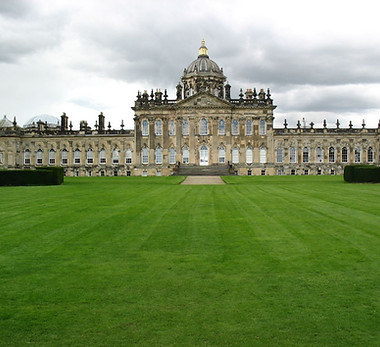
Like Blenheim, the main (north) façade of Castle Howard is organized around an impressive reception court. Sweeping wings frame a grand central block, accessed by a broad staircase adorned with giant pilasters and crowned by an ornate dome perched on a high drum. The south front of Castle Howard showcases Vanbrugh’s signature style, with its skyline bursting with dynamic and dramatic elements, creating a sense of unexpected grandeur and visual excitement.